
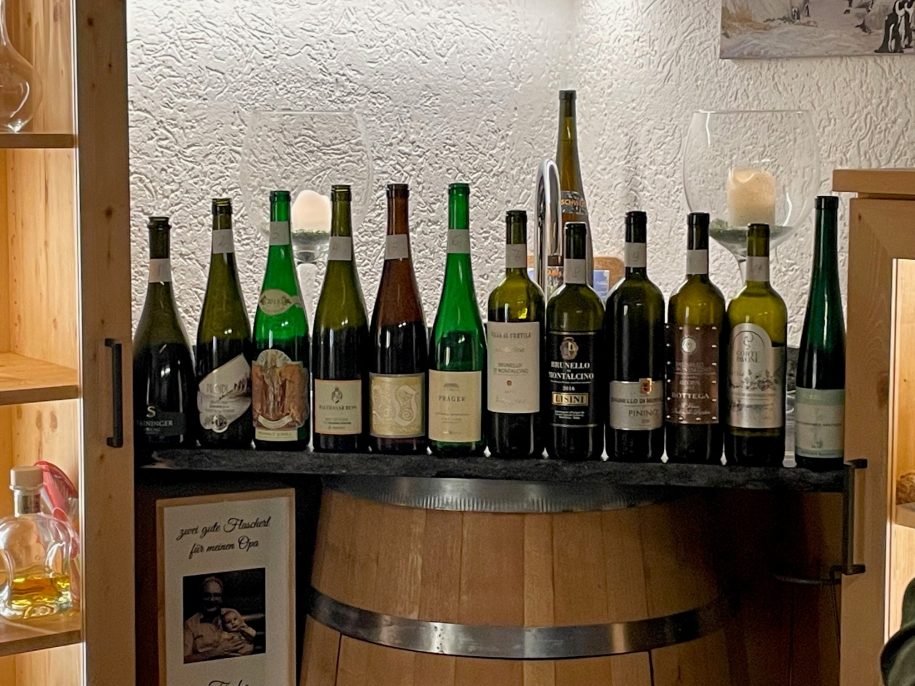
It was that time again. The DWINER tasting round this time had the theme Riesling from AT/DE and Sangiovese (older than 2017). Our tasting rounds take place every few weeks. All participants send a submission in advance consisting of at least 1 white wine and 1 red wine. Via the DWINER app a tasting list is created, which then goes to the cellar master. He then decides which wines are taken (of course without the other participants knowing).
This time it was extremely exciting again, the submissions were great, and we had a wonderful evening. For tasting notes we of course use our app, but we also fall back on proven methods now and then (notes on paper). Here you can download our template for free.
The cellar master usually adds another 1-2 wines (especially for aperitif and then the switch from white to red wine).
These white wines were on the lineup this time:
- STEININGER SEKT – Riesling Reserve 2019 (Aperitif), AT
- PROIDL – Ehrenfels 2015, AT
- KNOLL – Pfaffenberg Selektion 2015, AT
- KNOLL – Pfaffenberg Selektion 2015, AT
- BALTHASAR RESS – Riesling GG Ruedesheimer Berg Rottenland 2018, DE
- VON WINNING – Kalkofen 2017 GG, DE
- PRAGER – Wachstum Bodenstein 2015, AT
Red wines (Sangiovese, older than 2017):
- VILLA A CORTILE – Brunello di Montalcino Riserva DOCG 2015, IT
- ACIENDA AGRARIA LISINI – Brunello di Montalcino DOCG 2016, IT
- PININO – Brunello die Montalcino 2008, IT
- BOTTEGA – Brunello Riserva Pret-a-Porter 2013, IT
- CORTE PAVONE – Brunello di Montalcino Fiore del Vento 2013, IT
The tasting was rounded off with 2 Auslesen from ANSGAR CLUESSERATH (Trittenheimer Apotheke 2010) and HERMANN LUDES (Riesling OPTIMA Auslese) from 1993!
All in all, another more than successful event. There was also no real winner this time; all wines were in TOP condition and each a class of its own. The wines were checked out in DWINER and a tasting note attached to each. We already look forward to the next tasting.
Here are a few more facts about Riesling and Sangiovese:
Riesling
- Origin: Riesling originally comes from Germany and is closely linked to the wine regions along the Mosel, in the Rheingau, and in the Pfalz. However, there are also Riesling plantings in many other winegrowing regions worldwide.
- Grape characteristics: Riesling grapes are small to medium-sized, round, and greenish-yellow in color. Wines made from Riesling grapes are usually dry to sweet and have lively acidity.
- Aroma profile: Riesling wines are characterized by a complex aroma spectrum. They can show notes of citrus fruits (lemon, lime), stone fruits (peach, apricot), apple, flowers (acacia, jasmine), and mineral nuances. The aromas can vary depending on the growing region and winemaking.
- Style diversity: Riesling wines can be made in various styles, from dry to sweet. Dry Rieslings are usually light and refreshing, while sweet Rieslings have higher residual sugar and often excellent aging potential.
- Acidity: Riesling wines are characterized by their high acidity, which gives them freshness and longevity. This acidity also makes them excellent companions for a wide variety of dishes, from fish and seafood to Asian cuisine.
- Aging potential: Many Riesling wines can age for many years and develop complex aromas in the process. Some of the best Rieslings can even age for several decades.
- Distribution: Apart from Germany, Riesling is grown in many other countries, including France (especially Alsace), Austria, Australia, the United States (especially California and Washington State), New Zealand, and South Africa.
Riesling is a versatile grape variety that offers wine lovers a wide range of flavors and styles. From dry and crisp to sweet and nobly sweet, Riesling has something for almost every palate.
Sangiovese
Sangiovese is an important red grape variety that is native especially to Italy and responsible for some of the country’s most famous wines. Here is some key information about the Sangiovese grape variety:
- Origin: Sangiovese is an ancient grape variety native to Italy. It is grown especially in the Tuscany region, but is also found in other Italian winegrowing regions such as Umbria and Emilia-Romagna.
- Grape characteristics: Sangiovese grapes are medium-sized and have a thin skin. The grapes ripen relatively late and are susceptible to external influences, which can present growers with a certain challenge. The variety is sensitive to soil and climate conditions and can show different faces depending on where it is grown.
- Aroma profile: Sangiovese wines have a diverse aroma profile ranging from cherries, red berries, and plums to spices, flowers, and herbs. The aromas can vary depending on the growing region and winemaking.
- Style diversity: Sangiovese is used for a wide range of wine styles. Some of the most famous Italian wines made from Sangiovese grapes are Chianti, Brunello di Montalcino, and Vino Nobile di Montepulciano. These wines can range from light and fresh to powerful and tannin-rich.
- Tannins and acidity: Sangiovese wines often have firm tannins and balanced acidity, which give them structure and longevity. This makes them good candidates for storage and aging.
- Regions: Tuscany is the best-known growing area for Sangiovese, but the variety is also grown in other parts of Italy and in some other countries, including California and Australia.
- Popularity: Due to their versatility and quality, Sangiovese wines have gained international fame and are appreciated by wine lovers worldwide.
The Sangiovese grape variety is closely linked to Italian wine tradition and has produced some of the country’s most famous and sought-after wines. Its influence on wine culture in Italy and beyond is considerable.


Leave a Reply